Gluing or Glueing – What’s the Difference?
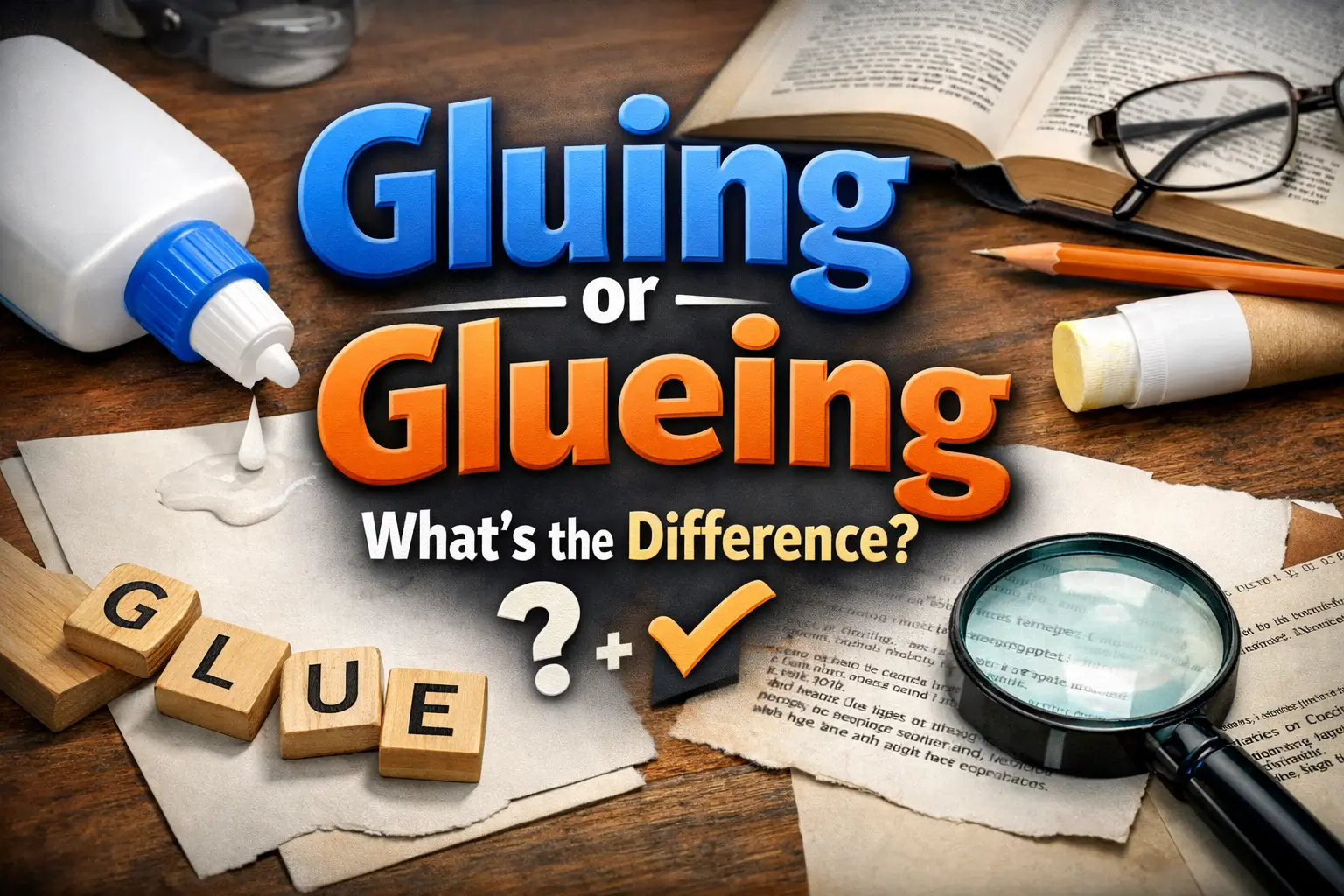
When it comes to English spelling, even simple words can create confusion—especially when they have more than one accepted form. A common example is “gluing” vs. “glueing.” At first glance, both seem correct because they are derived from the same base word, glue. However, English spelling follows certain patterns and rules that influence how words change when endings like “-ing” are added.
Understanding the difference between these two forms is important not only for correct writing but also for maintaining clarity and professionalism in communication. By looking closely at spelling rules and common usage, it becomes easier to determine which form is standard and how to use it correctly in everyday writing.
Difference Between Gluing and Glueing
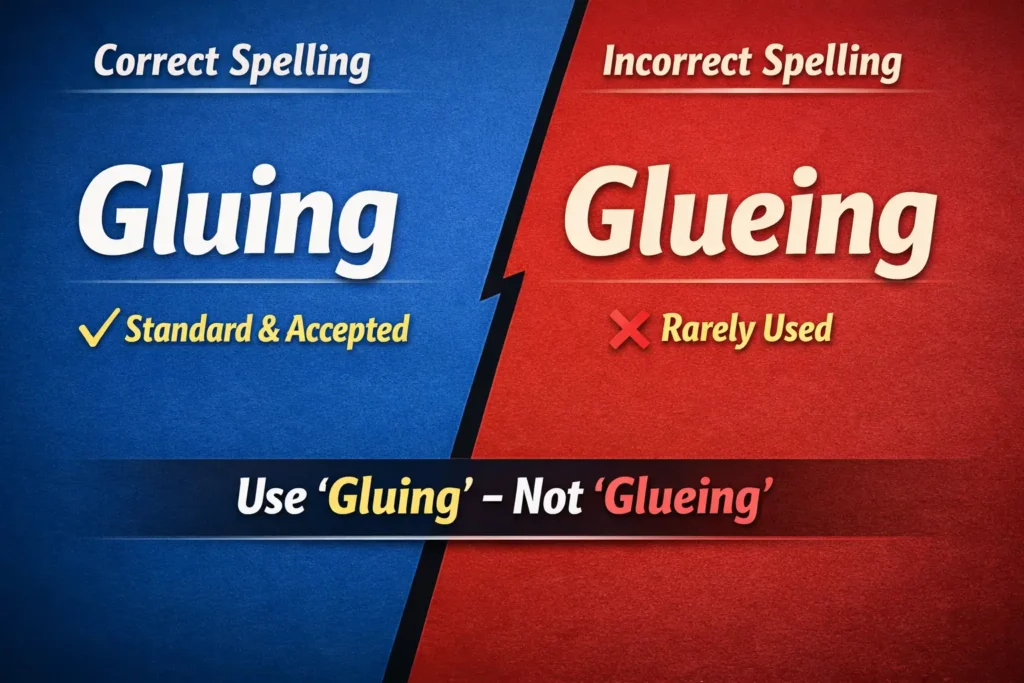
“Gluing” is the standard and correct spelling used in modern English, whereas “glueing” is a non-standard or outdated variation that is rarely used today. According to common spelling rules, the silent “e” at the end of “glue” is dropped before adding “-ing,” which forms “gluing.” This pattern is consistent with similar verbs like “writing” and “driving.”
Key Takeaways:
- Gluing: Correct and commonly accepted spelling.
- Glueing: Uncommon and generally avoided in standard usage.
- Usage: “Gluing” should be used in all types of writing, including formal, academic, and everyday contexts.
When to Use “Gluing”?
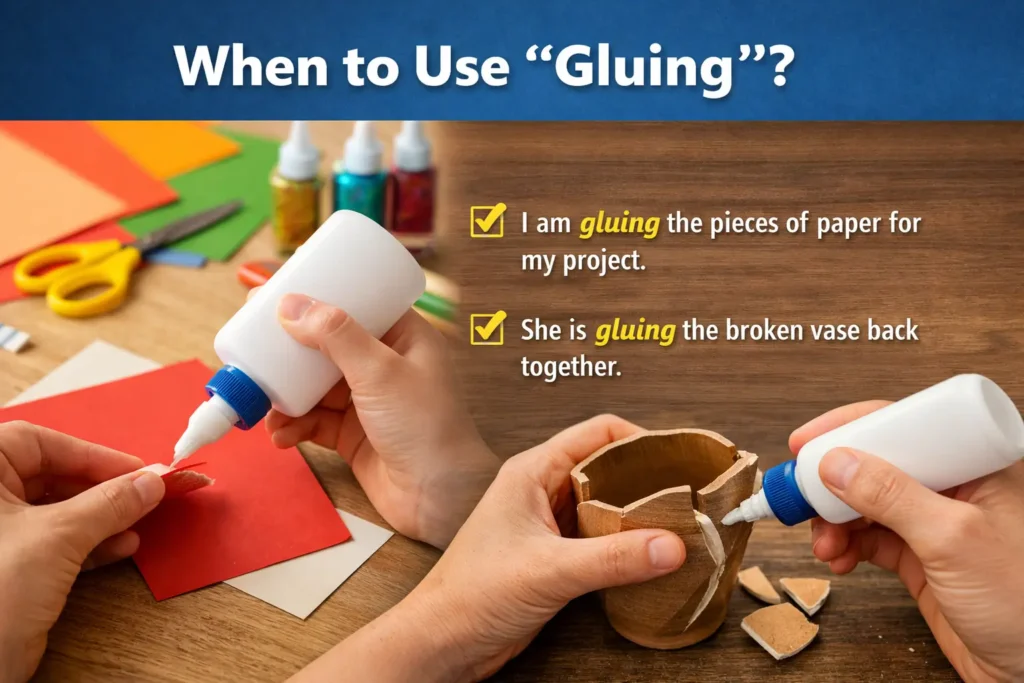
You should use “gluing” when you are talking about the action of sticking things together using glue. It is the correct present participle (verb + ing) form of “glue” and is used in both spoken and written English.
Easy Examples:
- I am gluing the pieces of paper for my school project.
- She is gluing the broken cup back together.
- They were gluing decorations on the wall.
- He is gluing the model parts carefully.
- In a sign of the times, officials in Hong Kong are gluing down bricks ahead of a visit by a top Chinese official, a move reportedly aimed at stopping protesters from turning pieces of pavement into projectiles. –The Washington Post
In all these sentences, “gluing” shows an action that is happening now or was happening in the past, which makes it the correct choice to use.
When to Use “Glueing”?
“Glueing” is considered a non-standard spelling and is generally avoided in modern English. While it may appear in some older texts or rare usages, it does not follow the common spelling rule of dropping the silent “e” before adding “-ing.” As a result, it is not accepted in formal writing, academic work, or professional communication.
Spelling Usage Over Time
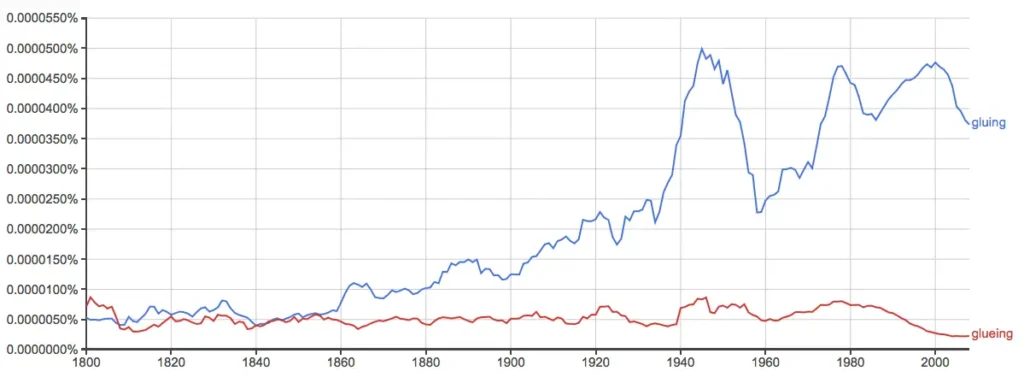
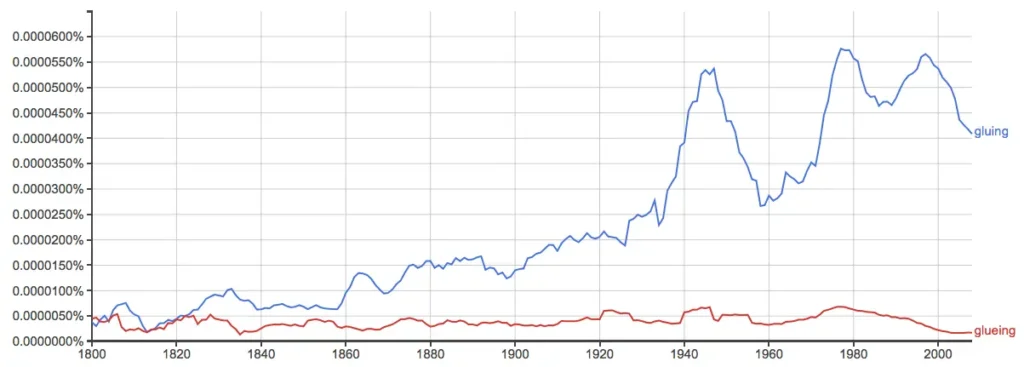
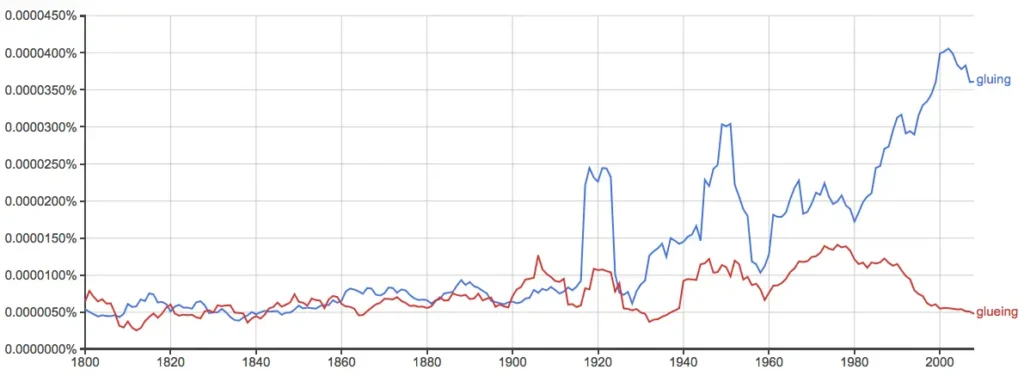
The data shown in the graphs clearly supports this. Over time, “gluing” has become overwhelmingly more popular, while “glueing” remains very rare. Although “glueing” has appeared occasionally since the 1800s, its usage has steadily declined and is now almost negligible compared to “gluing.”
In both American and British English, the trend is consistent, writers strongly prefer “gluing.” This shows that the spelling “glueing” is not widely accepted in any major English variant.
Conclusion:
- “Glueing” is outdated and rarely used.
- It should be avoided in correct English writing.
- Always choose “gluing” for accuracy and clarity.
Tricks to Remember the Difference
Remembering the correct spelling between gluing and glueing is actually very simple once you understand a few easy tricks:
1. Drop the Silent “E” Rule
In English, when a verb ends with a silent “e,” we usually drop the “e” before adding “-ing.”
- glue → gluing
- make → making
- write → writing
So just remember: no “e” before “-ing.”
2. Think: Shorter is Better
“Gluing” is shorter and cleaner, which often matches standard English patterns. If a spelling looks unnecessarily long (like “glueing”), it’s probably incorrect.
3. Say It Out Loud
When you pronounce “gluing,” you don’t hear an extra “e” sound. It sounds like gloo-ing, not gloo-ee-ing. That’s a clue that the extra “e” doesn’t belong.
4. Compare with Similar Words
Think of similar verbs:
- drive → driving (not driveing)
- write → writing (not writeing)
This helps reinforce that “gluing” follows the same rule.
5. One Simple Rule to Remember
“If the word ends in silent ‘e’, drop it before adding ‘-ing’.”
By using these easy tricks, you can quickly remember that “gluing” is the correct spelling, and avoid the common mistake of writing “glueing.”
Why Does This Confusion Happen?
The confusion between “gluing” and “glueing” mainly comes from the spelling of the base word “glue.” Since “glue” already ends with the letter “e,” many people assume that the “e” should stay when adding “-ing.” This leads to the incorrect form “glueing.”
Another reason is that English spelling rules can sometimes feel inconsistent, especially for beginners. Without knowing the rule of dropping the silent “e,” it’s easy to make this mistake. That’s why understanding basic spelling patterns is important for writing correctly.
Gluing in Different Tenses
Understanding how “glue” is used in different tenses can also make things clearer:
- Present: I am gluing the pieces together.
- Past: I glued the paper yesterday.
- Future: I will glue the parts later.
As you can see, “gluing” is only used in continuous (ongoing) actions, while other forms like “glued” are used for the past.
FAQs
1. Is “glueing” ever considered correct in any context?
In modern English, “glueing” is generally not considered correct. While it may appear in very old texts or rare cases, it is not accepted in standard writing today. You should always use “gluing.”
2. Why does “gluing” look unusual compared to other words?
“Gluing” may look a bit unusual because the “e” from “glue” is dropped, making the word shorter. However, this follows a common English spelling rule, so even if it looks odd at first, it is completely correct.
3. Do spell checkers recognize “glueing”?
Most modern spell checkers and grammar tools mark “glueing” as incorrect or suggest “gluing” as the correct form. This is because “gluing” is the standard spelling used today.
4. Is there any difference in meaning between “gluing” and “glueing”?
No, there is no difference in meaning. Both forms refer to the same action of sticking things together. The only difference is that “gluing” is correct, while “glueing” is not standard.
5. Can “gluing” be used in formal and academic writing?
Yes, “gluing” is completely acceptable in formal, academic, and professional writing. It is the correct spelling and follows standard English rules.
6. Are there other words similar to “glue” that confuse learners?
Yes, many English words cause similar confusion, especially those ending in “e,” such as “hope” (hoping), “make” (making), and “write” (writing). Learning the rule of dropping the silent “e” helps avoid these mistakes.
7. How can I quickly check if my spelling is correct?
You can use tools like spell checkers, dictionaries, or grammar apps. Reading your sentence out loud and checking similar word patterns can also help you confirm the correct spelling.