That’s vs Thats: Meaning and Correct Usage Explained
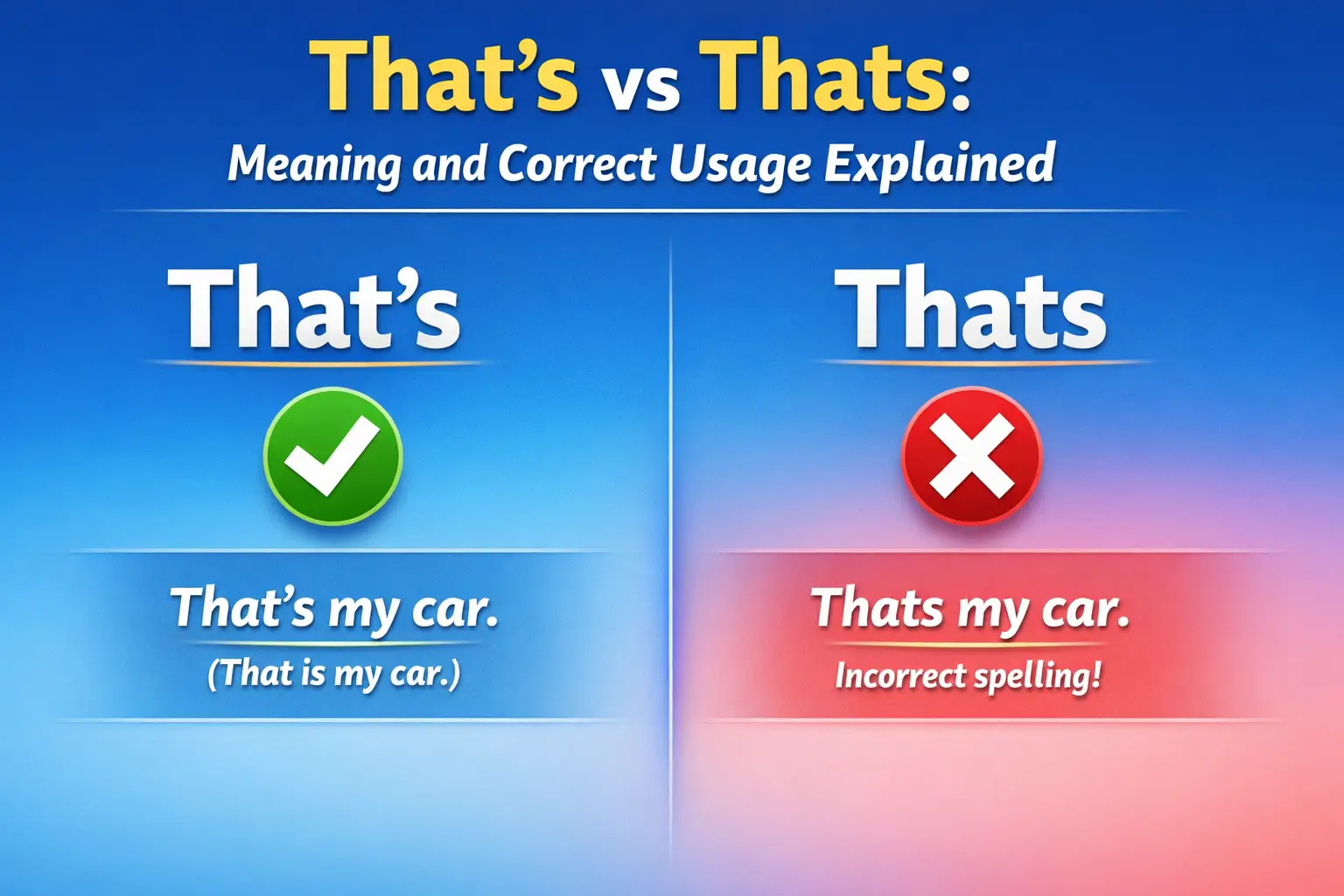
The correct form is “that’s” with an apostrophe. It is a contraction of “that is” or “that has.”
The form “thats” (without an apostrophe) is incorrect in standard English and should never be used in formal writing.
In simple words:
- If you mean “that is” or “that has,” always write “that’s.”
- Writing “thats” is a grammar mistake.
What Is “That’s”?
“That’s” is a contraction, which means it is a shortened form of two words.
- That’s = That is
- That’s = That has
It is very common in both spoken and written English, especially in casual conversations.
When to Use “That’s” (With Examples)
1. When It Means “That Is”
Use “that’s” when you can replace it with “that is.”
Examples:
- That’s my car. → That is my car
- That’s a beautiful dress. → That is a beautiful dress
- That’s not true. → That is not true
- That’s the problem. → That is the problem
These are very common in daily conversations.
2. When It Means “That Has”
Use “that’s” when you can replace it with “that has.”
Examples:
- That’s been a long journey. → That has been a long journey
- That’s happened before. → That has happened before
- That’s already finished. → That has already finished
This use is slightly less common but still correct.
Why “Thats” Is Incorrect?
“Thats” without an apostrophe is not a real word in proper English.
It usually happens because:
- People forget the apostrophe
- Typing quickly on mobile
- Not knowing grammar rules
Wrong vs Correct Sentences
Here are clear comparisons:
- ❌ Thats my friend
✅ That’s my friend - ❌ Thats why I called you
✅ That’s why I called you - ❌ Thats a good idea
✅ That’s a good idea - ❌ Thats been difficult
✅ That’s been difficult
Real-Life Examples (Used in Daily Conversations)
These examples will help you understand how native speakers use “that’s” naturally:
- That’s exactly what I needed.
- That’s why I didn’t come yesterday.
- That’s so funny!
- That’s the best movie I’ve ever seen.
- That’s not how it works.
- That’s your responsibility.
- That’s been bothering me all day.
“That’s” in Formal vs Informal Writing
Informal Writing (Allowed)
- Text messages
- Social media
- Blogs
- Conversations
Example:
👉 That’s fine, don’t worry about it.
Formal Writing (Better Alternative)
In formal writing, you may prefer full forms:
- That is better than this.
- That has already been completed.
But “that’s” is still grammatically correct, even in formal English—just slightly less formal.
Common Confusions
1. “That’s” vs “That”
- That’s = That is / That has
- That = a determiner or pronoun
Example:
- That’s my book.
- That book is mine.
2. “That’s” vs “Those”
- That’s = singular + contraction
- Those = plural
Example:
- That’s a car.
- Those are cars.
3. “That’s” vs “Its”
This is another common confusion:
- That’s = That is / That has
- Its = shows possession
Example:
- That’s a dog.
- Its tail is long.
Easy Trick to Remember
Here’s a simple trick:
👉 Replace the word with “that is”
- If the sentence still makes sense → use “that’s”
- If not → check again
Example:
- That’s amazing → That is amazing
- That’s been done → That has been done
Why This Mistake Is Common?
Many people write “thats” because:
- They ignore punctuation
- They are used to texting shortcuts
- They don’t know contraction rules
But in correct English, apostrophes are very important.
Quick Practice (Test Yourself)
Choose the correct option:
- ___ my phone.
- ___ why she left.
- ___ been a long day.
Answers:
- That’s
- That’s
- That’s
Final Summary
- ✅ That’s = correct (means “that is” or “that has”)
- ❌ Thats = incorrect (missing apostrophe)
👉 Always use “that’s” in proper English.
👉 Never write “thats” in formal writing.
FAQ’s
1. Can “that’s” be used at the beginning of a sentence?
Yes, “that’s” can start a sentence in informal and formal writing. Example: That’s the reason I didn’t agree.
2. Is “that’s” used in British and American English both?
Yes, “that’s” is used in both British and American English in the same way.
3. Does “that’s” always mean agreement?
No, “that’s” does not always show agreement. It can also be used for explanation or description. Example: That’s interesting information.
4. Can “that’s” be used in negative sentences?
Yes, it can be used in negative form. Example: That’s not what I expected.
5. Is “that’s” used in questions?
Yes, “that’s” can appear in questions, especially in spoken English. Example: That’s okay with you?
6. Can “that’s” refer to future actions?
No, “that’s” is generally not used for future tense directly. It usually refers to present or past context.
7. Is “that’s” formal or informal?
“That’s” is neutral, meaning it is acceptable in both informal and formal English, but full forms are preferred in very formal documents.
8. Can “that’s” be replaced with “this is”?
No, “that’s” and “this is” are not interchangeable because they refer to different levels of distance or context.
9. Does “that’s” change in plural form?
No, “that’s” does not have a plural form because it only refers to singular “that.”
10. Is “that’s” used in professional emails?
Yes, “that’s” is commonly used in professional emails, especially in friendly or semi-formal communication.